Fire extinguishers are something we see every single day but fortunately not many of us are ever required to use one. However, ask yourself if you find yourself faced with a fire at home or work, are you confident that you know how to use a fire extinguisher safely. While many people think operating a fire extinguisher is easy there is a good chance they are not entirely sure how to use one properly.
One of the problems you face where fire extinguishers are concerned is that there are a number of different types all containing different liquids. Not every fire extinguisher works in the same way and some are only suitable for use on particular types of fire.
In this guide we will not only provide you with information on how to use the different types of extinguisher, but also tell you which fires to use them on. It is essential that you understand which extinguisher should be used in the outbreak of fire because using the wrong one could cause the fire to escalate putting anyone in the vicinity at risk.
For uncontained liquid fires: Direct the discharge hose above the fire and gently press the lever, sweeping the nozzle slowly over the fire in a controlled motion. The powder will quickly suppress the flames, but there is a risk of re-ignition once it settles. To prevent this, apply a foam extinguisher over the spill to ensure the fire does not reignite. It is not advisable to use a Dry powder extinguisher indoors unless you have undertaken a Health and Safety risk assessment. The reason for this is that if anyone living in, working or visiting the property has respiratory problems they could be aggravated by it.
Take it to a recycling centre.
Most larger recycling centres accept fire extinguishers for disposal.
For safety reasons, local authorities may ask you to tape the handles together or keep the safety pin in place. If the extinguisher is a CO2 type, you should keep the swivel horn in place or fit a blanking plate.
Dismantle the cylinder.
You can dismantle the cylinder and recycle it using standard metal recycling techniques. You can also recycle other materials such as plastics and rubber.
Use a specialist.
If you have a large amount of fire extinguishers, you can hire a specialist or servicing company to dispose of them for you.
Never use a fire extinguisher to put out flames from a fire that involves escaping gases.
Only ever tackle fires that are in their very early stages.
Never move forward unless you are sure it is safe to do so, but it is imperative you remain 1 metre from the fire at all times.
Never use more than one fire extinguisher to tackle a fire.
How To Use a Water Fire Extinguisher
A water fire extinguisher is only suitable for use on Class A fires which are those involving things such as wood, paper and cloth.- Before attempting to put out the fire with a water extinguisher make sure there are no electrics involved and there is no live electrical equipment in the vicinity.
- In the case of small fires you should stand a minimum of 3 metres away.
- Then break the tamper proof seal and pull out the pin.
- Take hold of the operating lever with one hand while using the other to take the nozzle of the hose out of its holder. The discharge hose should be held at least 5 cm from the nozzle.
- You must always keep the extinguisher in an upright position while holding it.
- Pointing the extinguisher away from the fire and squeeze the handle gently giving it a short burst to make sure it is working properly.
- When putting out the fire aim the extinguisher at the back of base squeezing the lever gently and sweeping the nozzle from side to side across the entirety of the fire.
- Make sure you have discharged the extinguisher completely and that the fire has been completely extinguished.
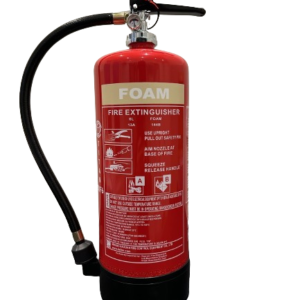
How To Use a Foam Fire Extinguisher (For Class A and B Fires)
Foam fire extinguishers can be used on class A fires ( solid materials ) as well as class B fires which are those fueled by liquids such as oils and petrol. When you approach a class B fire it is important that any flowing liquids are contained. As with class A fires care must be taken that there are no electrics involved or live electrical equipment nearby. A Foam extinguisher operates in the same way as a water extinguisher when dealing with class A Fires so follow the instructions outlined above to safely use it.In the Case Of Contained Flammable Liquids You Should:
Point the nozzle at the side of the fire, gently press the lever, and spray the extinguishing agent over the fire.For Uncontained Liquid Fires
Make sure you aim over the top of the fire which will allow the foam to fall onto the fire and use a slow sweeping action so the foam can be discharged all along the fire. Do not aim the nozzle at the fire as it will cause flames to spread. Make sure you have fully discharged the extinguisher and that the fire has been completely put out. Before finishing check the fire has not reignited.How To Use a CO2 Fire Extinguisher (Used For Class B and Electrical Fires)
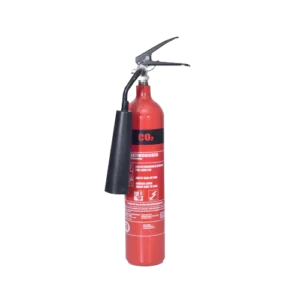
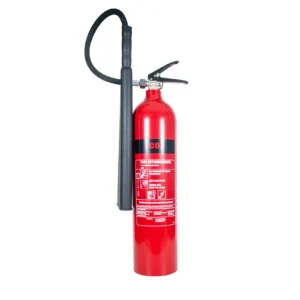
Co2 fire extinguishers can be used on both flammable liquids and electrical fires. A CO2 extinguisher is used in a different way to both foam and water extinguishers. First thing you need to know is:- It is important that you never place your hands on the horn of the fire extinguisher during use or after it has been discharged, as the hose will cause freeze burns on your hands.
- If the fire is small and you are fully trained to extinguish a fire, stand at least 1-3 metres from the fire with the appropriate extinguisher in hand.
- Break the tamper proof seal and pull the pin.
- Lift the horn until it is at a 90 angle to the cylinder of the fire extinguisher.
- Make sure the operating lever is held with both hands.
- The fire extinguisher must stay in an upright position during use.
- Face the fire extinguisher away from the fire, and gently squeeze the handle for a short sharp burst – this is to ensure it works.
How To Use a dry Powder Fire Extinguisher (Used For Classes A, B, C and Electrical Fires)
Dry powder fire extinguishers are suitable for use on Class A,B and C fires along with electrical fires. When operating a dry powder extinguisher follow the same process as you would with water and foam models the only difference being that you should stand slightly further away 5-7 metres.For uncontained liquid fires: Direct the discharge hose above the fire and gently press the lever, sweeping the nozzle slowly over the fire in a controlled motion. The powder will quickly suppress the flames, but there is a risk of re-ignition once it settles. To prevent this, apply a foam extinguisher over the spill to ensure the fire does not reignite. It is not advisable to use a Dry powder extinguisher indoors unless you have undertaken a Health and Safety risk assessment. The reason for this is that if anyone living in, working or visiting the property has respiratory problems they could be aggravated by it.
What are The Four Steps For Using a Fire Extinguisher?
The four steps for using a fire extinguisher are know by the acronym PASS which stands for:- Pull – This relates to the pulling the pin and breaking the seal
- Aim – Aim at the bass of the fire
- Squeeze – gently squeeze the handle to discharge the extinguisher over the fire
- Sweep – keeping it pointed at the base of the fire sweep the extinguisher from side to side until you have extinguished the fire.
When Should You Use a Fire Extinguisher?
You should only use a fire extinguisher in the following circumstances.- You are faced with a relatively small, contained fire that is not showing signs of spreading quickly.
- You have access to a clear exit route that will still be unblocked even if you don’t succeed in putting out the fire.
- You have undergone fire extinguisher training within the last year.
- The fire service have been notified.
- The room is not filled with smoke.
- You are certain which type of fire you are dealing with and the correct extinguisher to use.